



Let’s be honest, guys: if you’re an indie developer building an extension, the biggest headache isn’t the code – it’s monetization. I personally only needed one attempt to realize that building my own backend for license checks, subscription management, payment processing (and praying the tax man doesn’t call) is weeks of lost time.
Google used to handle this for us with Chrome Web Store Payments, but as we know, they shuttered that service. That’s where ExtensionPay stepped onto the stage.
I’ve researched how it works, and I’m ready to share my thoughts: Is giving up 5% of your revenue actually worth it?
What Exactly Is ExtensionPay?
Think of ExtensionPay as your own personal, invisible, and free-to-start backend that focuses solely on one thing: money and licensing for your browser extension.
Instead of:
- Spinning up a server.
- Setting up Stripe (or another gateway).
- Writing logic to check if a user in London paid for their yearly subscription.
- Creating a multi-device login system.
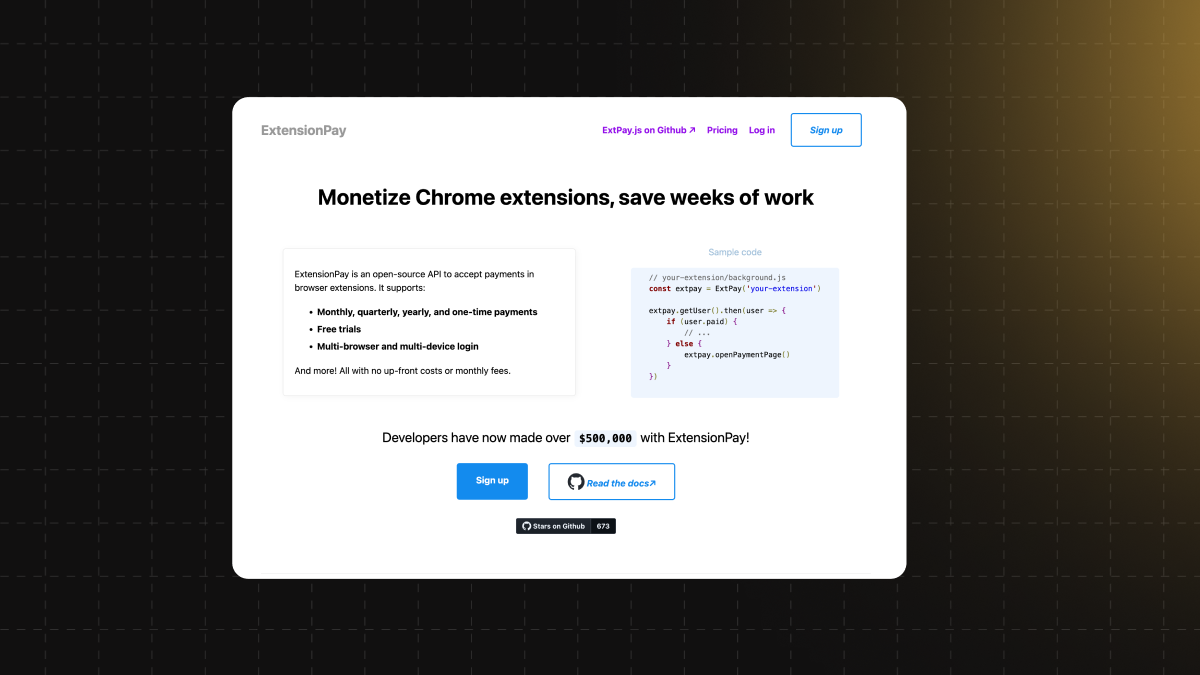
…you just add a small JavaScript library (which is open-source, by the way) and call one function:
// your-extension/background.js
const extpay = ExtPay('your-extension')

extpay.getUser().then(user => {
    if (user.paid) {
        // ...
    } else {
        extpay.openPaymentPage()
    }
})
That’s it. Done.
My Experience: Why I’d Pay the 5%
When I first started out, I would have paid anything for a service like this. Here are the main pros that really appeal to me:
1. Launch Speed (MVP in a Day)
This is the main selling point. If you have a killer extension idea, you can launch a paid MVP (minimum viable product) in a matter of hours. You don’t waste weeks on “boring” infrastructure. You can immediately validate whether people are willing to pay for your feature.
2. Painless Cross-Browser Support
Unlike Google’s old system, ExtensionPay works everywhere: Chrome, Firefox, Edge, Brave. This means you write your payment logic once and instantly reach all markets, maximizing your revenue potential. That’s a massive advantage.
3. No License Keys (A Better User Experience)
I love that ExtensionPay solves the login nightmare. Users don’t have to copy and paste some clunky activation key to use your extension on both their laptop and desktop. They simply log in as they would to any web app, and ExtPay securely validates their subscription via Stripe. It’s a huge win for UX.
4. Security and Reliability
The payment system is integrated with Stripe (the global standard), allowing you to accept payments from 135+ countries and bill in local currencies. The developers claim the license check is securely protected against tampering.
The Catch: Where Does the 5% Go?
Of course, nothing truly good in life is free. In ExtensionPay’s case, the catch is the transaction fee.
The Cost: 5% of the transaction.
This is not a monthly fee, but it’s on top of the fee that Stripe already takes (typically 2.9% + $0.30).
What this means:
- The Downside: If you sell your extension for $10/month, you lose around 7–8% ($0.70–$0.80) of every transaction. On high volumes, this can add up significantly.
- The Upside: You only pay when you make money. There is zero risk. If your extension doesn’t take off, you haven’t spent a dime (other than your time, of course).
The Real Problem: It Feels Like an MVP Itself
Here’s the critical point that makes me seriously pause before recommending ExtensionPay for a long-term business. While the code library is efficient, the service itself, as a business platform, feels hastily put together.
1. The “Hacked Together” Website Vibe
When you’re dealing with user payments, the platform needs to instill absolute trust. Unfortunately, ExtensionPay’s public-facing site and documentation feel bare-bones and quickly assembled. This lack of polish is a major psychological hurdle. If I’m putting my entire business’s revenue through a service, I need it to look and feel like a professional enterprise, not a weekend project.
2. The Missing Admin Dashboard
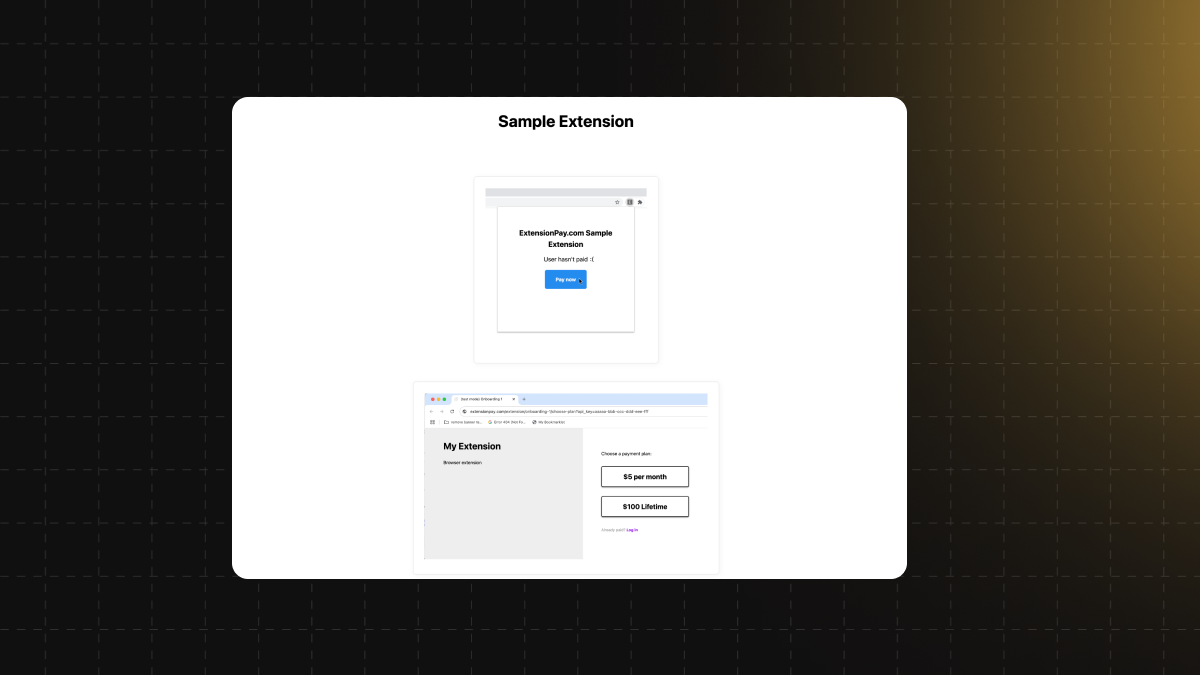
This is a dealbreaker for scaling. There is no proper admin panel or centralized dashboard for developers. You can’t:
- View your monthly recurring revenue (MRR) at a glance.
- Easily manage specific customer subscriptions or issue refunds yourself.
- Generate detailed reports for accounting or tax purposes.
- Manage a wide range of promotional codes or special offers effectively.
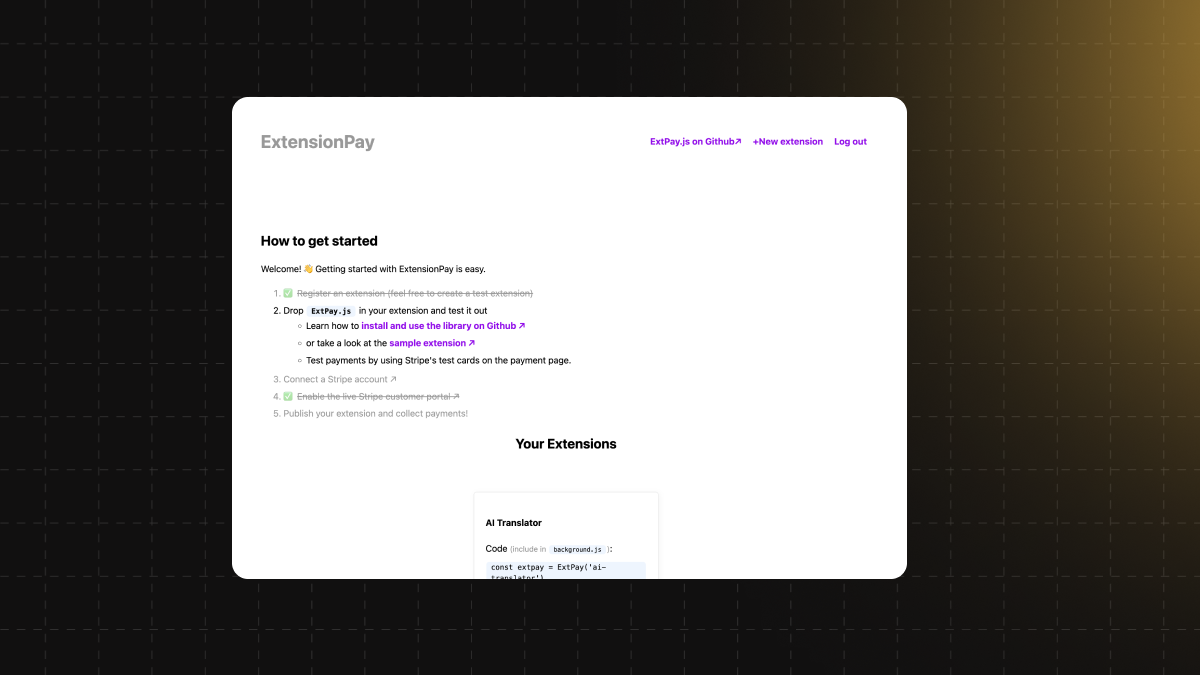
Essentially, your entire business data is fragmented between ExtensionPay’s minimal interface and the Stripe dashboard. This means more manual work for you, the developer, defeating the purpose of paying for an automated service. It’s a tool for coding speed, not for business management.
My Verdict: Should You Use It?
The answer depends on who you are and where your project is.
| Your Role | My Recommendation | Why? |
| Indie Hacker / Beginner | Absolutely YES. | You need to validate your idea, not become a Stripe API expert. ExtensionPay gives you the most valuable thing: time. |
| Mid-Level Dev with a Potential Hit | YES, as a temporary solution. | Use it to launch and hit your first $10k–$20k. Once your revenue climbs past a certain point ($5k+/month), consider migrating to your own backend to save that 5% fee. |
| Large SaaS or Enterprise Project | NO. | At this scale, 5% is massive money that could be spent hiring a backend engineer or improving your product. Full control over data and payments becomes critical. |
The Hidden Cost of Migration: Subscription Continuity
You mentioned the critical point that many developers overlook: migrating off a platform like ExtensionPay introduces a major risk to your existing revenue stream.
When you switch from ExtensionPay (which uses its own Stripe tokens) to your own self-hosted backend (which uses your own Stripe tokens), you face a serious continuity problem:
- Payment Token Migration is Complex: Due to PCI compliance and security protocols, you cannot just export user credit card numbers. You must migrate the customer tokens and subscription objects from ExtensionPay’s account to your own.
- Customer UX Risk: This process is messy and prone to failure. If not handled perfectly, users’ next payment renewals will fail, leading to service disruption, angry emails, and high churn. You must communicate the change to users and potentially ask them to re-enter payment information, which is a big ask.
- The Unwanted Backend Project: Migrating means you now have to build the entire licensing, payment, and refund system you tried to avoid in the first place – but now you have the pressure of live, paying users who cannot lose service.
Ultimately, your decision comes down to your primary goal. ExtensionPay is the perfect tool to save 50 hours of backend work and launch immediately. For the indie hacker validating an idea, 5% is a fair price for peace of mind and zero server maintenance.
However, be warned: if you project hitting $5k MRR, the cost of saving that 5% now is the huge headache of building a live migration tool later. If scaling is your immediate goal, it’s smarter to start with a self-hosted solution – or leverage serious, mature subscription management platforms – earlier to secure your revenue stream from day one.
Are you willing to sacrifice 5% for launch speed?